An Airflow Sensor Pair for 3D Wind Detection and Mapping on Nano Quadrotors
L. Thomas, S. Bergbreiter
My contributions
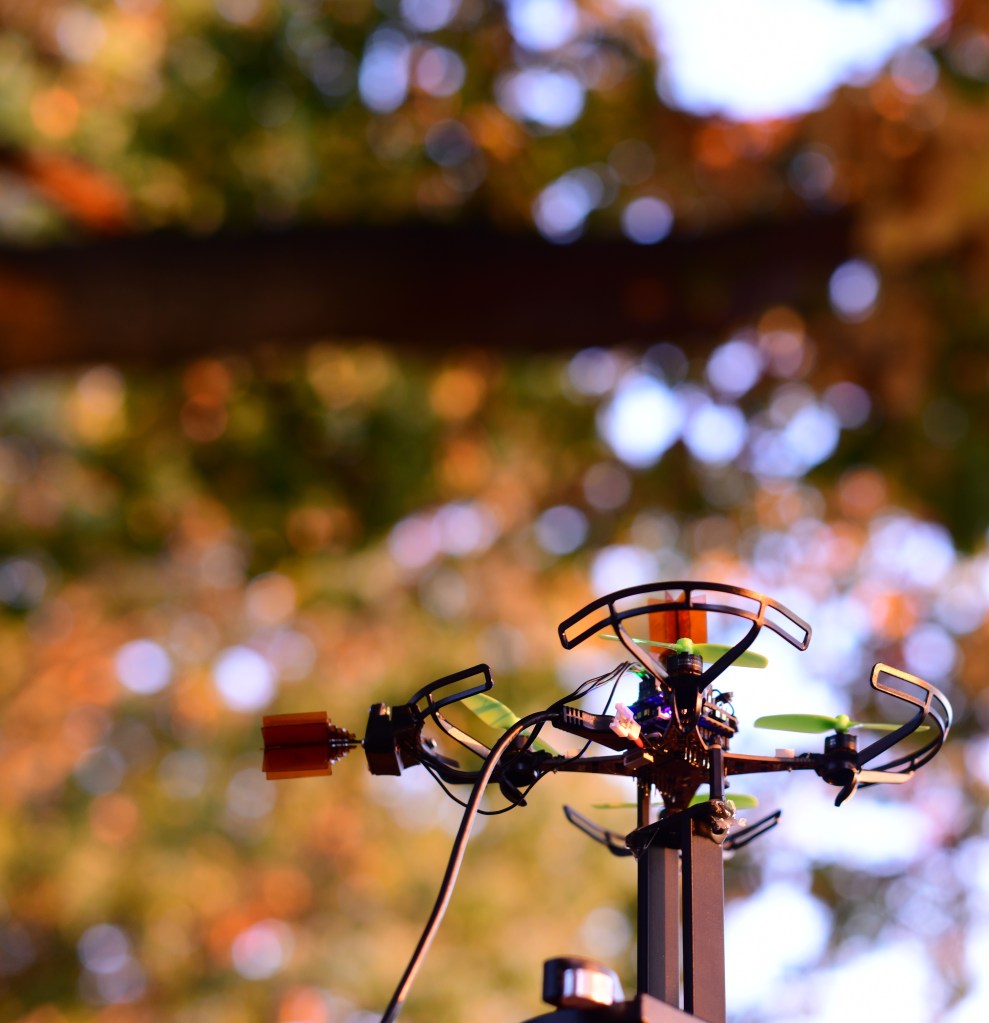
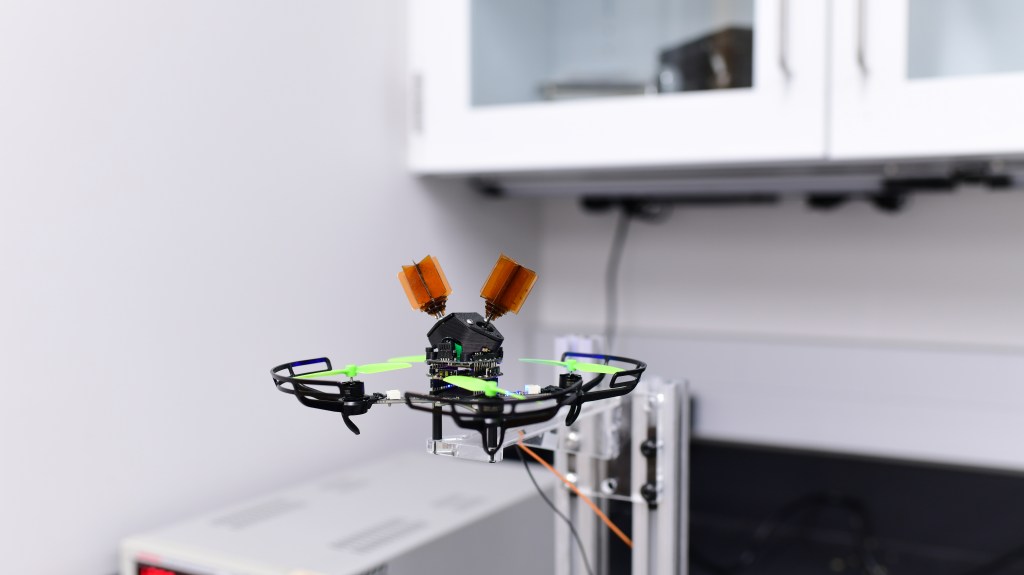
- Developing hardware and software for a dual whisker-inspired magnetic airflow sensor system for 3D wind vector estimation on < 50 g
quadrotors, for wind field mapping data to improve wildfire prediction models in dense, under-canopy regions in forests - Redesigned the airflow sensor in CAD for a two-sensor payload, shrinking the laser-cut fin from 50 mm to 20 mm and casting a softer
silicone spring to preserve sensitivity, then 3D-printing two sensor layouts using ABS plastic weighing ∼10 g each - Designed a 1.6 g custom PCB and hand-assembled 0805 SMD components including an I2C multiplexer and onboard microcontroller to
interface two 3-axis magnet sensors with the quadrotor - Built an automated wind tunnel from 80/20 extrusions, PC cooling fans, 3D printed flow straightening elements, and a motorized stage
enabling least squares sensor calibration resulting in 0.06 m/s measurement error, matching performance of commercial wind sensors - Evaluating a dual-inboard sensor layout against an inboard plus outboard layout through observability analysis, noise characterization,
and in-flight testing to select the optimal configuration that balances rotor disturbance rejection with measurement accuracy

Onboard Airflow Sensing for Odor Source Localization on a 50 g Quadrotor
L. Thomas, T. Bridges, S. Bergbreiter
Published in Advanced Robotics Research
My contributions
- Built a lightweight, onboard wind and chemical sensing system that enables closed-loop, aerial plume tracking on a 50 g drone, reaching
the plume source in 12/12 indoor trials and in 3/4 trials when deployed outdoors in natural wind - Ruggedized a magnetically-transduced, whisker-inspired airflow sensor by transitioning the torsional spring material from lasercut steel to
3D-printed 40A silicone, improving measurement variability by 58%, and tolerating high-velocity (2-8 m/s) crashes without damage - Miniaturized sensor package from 15.6 g to 9.6 g by designing 3D printed housing and integrating electronics on a custom PCB containing
a microcontroller, gas sensor, and connection points for the magnetic transducers for the airflow sensor for integration with the quadrotor - Built an Unscented Kalman Filter-based wind-presence estimator in Python that fused the airflow measurements with the drone’s
odometry to detect ambient wind as low as 0.2 m/s even during self-motion - Implemented PID controller in Python using the wind sensor as an input to continuously steer the drone’s heading and motion upwind
whenever a wind-driven plume was detected, fully aligning the drone with the plume centerline in as little as 1.2 seconds

Asymmetric Whisker-Inspired Sensor Pairs for Enhanced Airflow Sensing on Drones
T. Kent, L. Thomas, S. Bergbreiter
View Paper
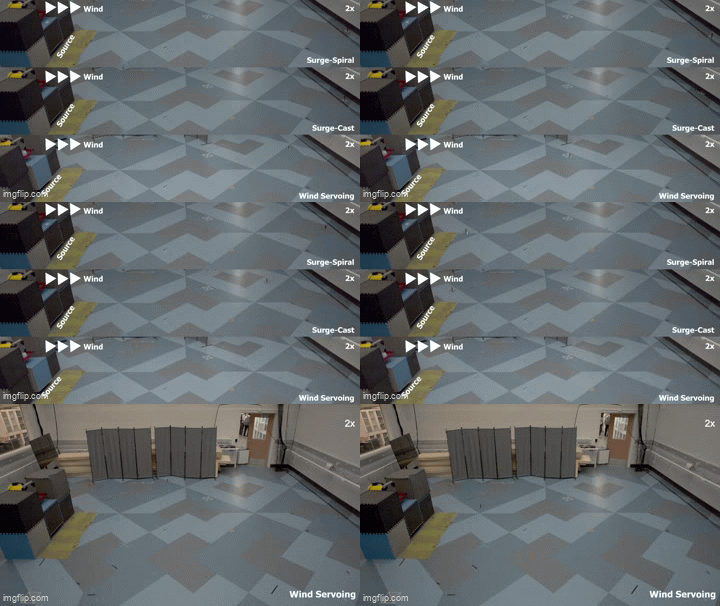
Straight to the Source: A Wind-Driven Approach for Faster Odor Source Localization on a Micro-Quadrotor
L. Thomas, Tjaden Bridges, Sarah Bergbreiter

Airflow Source Seeking on Small Quadrotors Using a Single Flow Sensor
L. Thomas, Tjaden Bridges, Sarah Bergbreiter

